One keyboard, made to travel between your languages.
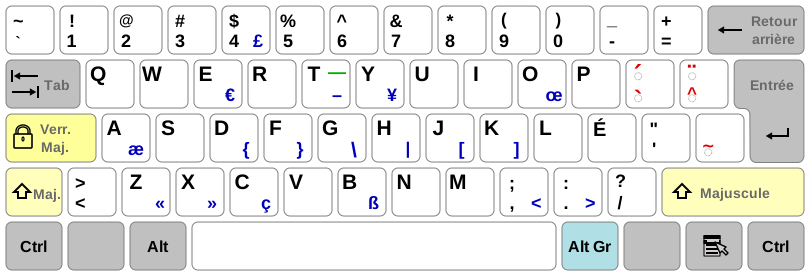
Keep the standard QWERTY you already know, and add a light local-language layer that brings your accents and special characters within reach. A free, open-source project — starting with French, Italian and German.
01
The problem
Crossing a language shouldn't mean fighting your keyboard. Switch to a national layout and your code symbols move; stay on US QWERTY and your accents disappear. Today the choice is between typing fast and writing properly — in your own language.
02
The idea
QWERTY Global keeps about 95% of the keyboard you already use, and changes only what your language actually needs. A few smart keys — a signature letter and a handful of accent keys — form a local-language layer on top of a base that stays the same. Same muscle memory, more languages.
03
For people who code
Your { } [ ] | \ stay in consistent places across languages, reachable from the home
row. So you can move between projects, machines and languages without relearning where your symbols
live — and still write your own language with full accents, including capitals.
04
The languages
We're starting with French, Italian and German, with more European languages to follow. Tell us which one you type in, and we'll prioritise accordingly.
- Français
- Italiano
- Deutsch
05
The research
We work with ergonomics in mind. Studies are underway to understand how small, well-placed changes affect typing — we'd rather measure carefully than over-claim, so we'll share findings as they come.
06
Open & free
QWERTY Global is a free, open-source project carried by the AMCF, a non-profit. No lock-in, no hidden cost — just a better way to type across languages.
- Free
- Open-source
- Non-profit
- No lock-in
Be among the first to try it.
Leave your email and we'll let you know when an early version is ready to test. No spam, no commitment.